Sunday, March 27, 2016

BW13 - Book news and links


Happy Easter to all who celebrate!  April is coming quickly and will be a full month as we sail the seas and explore with Charles Darwin in Voyage of the Beagle.  Our very own Rose (Chrysalis Academy) will be guiding our travels and will be guest posting next week.   


The blogosphere  event of the year begins on April 1: the 7th annual  Blogging from A to Z challenge.   If you have a blog and have gotten out of the habit or just need some inspiration, be sure to check it out.  I'm diving in with both feet. 

April 12 is Beverly Cleary's 99th birthday and ALA is celebrating all month long with D.E.A.R. - Drop Everything and Read Month.  


April 23rd is World Book and Copyright day created by UNESCO in honor of Cervantes, Shakespeare and Inca Garcilaso de la Vega all died in 1616 on this day. Eliana will be leading the charge so stay tuned for more information.


April is also National Poetry Month  and in celebration Bill Murray contributed his favorite poems to O magazine 
 available in the April Issue now.

Have you found your bliss yet? Brianpickings highlights Joseph Campbell with What it Takes to Have a Fulfilling Life.

If you follow your bliss, you put yourself on a kind of track that has been there all the while, waiting for you, and the life that you ought to be living is the one you are living. Wherever you are — if you are following your bliss, you are enjoying that refreshment, that life within you, all the time.


Book Kids Blog is celebrating National Poetry Month with 26 Inspiring Poems about the Joys and Importance of Books and Reading


I Opened a Book
By Julia Donaldson

I opened a book and in I strode.
Now nobody can find me.
I’ve left my chair, my house, my road,
My town and my world behind me.

I’m wearing the cloak, I’ve slipped on the ring,
I’ve swallowed the magic potion.
I’ve fought with a dragon, dined with a king
And dived in a bottomless ocean.

I opened a book and made some friends.
I shared their tears and laughter
And followed their road with its bumps and bends
To the happily ever after.

I finished my book and out I came.
The cloak can no longer hide me.
My chair and my house are just the same,
But I have a book inside me.

*****************************************************
Please link to your specific post and not your general blog link. In the Your Name field, type in your name and the name of the book in parenthesis. In the Your URL field leave a link to your specific post. If you don't have a blog, leave a comment telling us what you have been reading. 


Sunday, March 20, 2016

BW12: Vernal Equinox


Spring has arrived in the northern half of the hemisphere and Autumn has already come out to play at the beginning of the month in the southern half.  Whether you are experiencing flowers blooming or leaves turning all shades of yellow, red and orange, nature is putting on quite a show right now.  It's also time to pull out your trusty thesauruses or thesauri, which ever you prefer saying  and start plotting out your spring or autumn reading lists.  Or maybe take a look at Synonyms.com and see what you can find. Perhaps a book with capriole or galumph or caper in the title!

I think I'm going to take a different tack with Spring this year since the season is all about beginnings, growth, discovery and blossoming. A new copy of  Julia Cameron's The Artist's Way just arrived. I signed up to join a group of folks in my online writing community who will be diving in on April 7th. I read it a few years back and since then my original, very marked up, well used copy disappeared into the garage, boxed up along with numerous other books while we deep cleaned our bedroom. So I splurged on another copy - it is, after all, a new beginning...again.  *grin*  

Also in the offing is the annual April challenge -  Blogging from A to Z - created by Arlee Bird, and is now in its 7th year.  This will be my first time participating and I'm looking forward to it with excitement as well as trepidation.  As of March 21st, My Two Blessings will be nine years and as my posting has become rather sporadic lately, am attempting to get back into the groove.  Come join me and all the riotous fun. Come up with a theme and talk about books, life, homeschooling, clowns, engineering, maps or whatever your clever and intriguing minds think up.  

Still need some ideas for Spring or Autumn -- Check out The Millions Most Anticipated: The Great 2016 Book Review or  for something completely different - The 18 Books that investors will be reading over Spring Break!

Happy Reading! 


**************************************************************************
Please link to your specific post and not your general blog link. In the Your Name field, type in your name and the name of the book in parenthesis. In the Your URL field leave a link to your specific post. If you don't have a blog, leave a comment telling us what you have been reading. 


Sunday, March 13, 2016

BW11: Happy St. Patrick's Week!

We'll be celebrating St. Patrick's day all week long and instead of loading your wishlists down with more books, your mission is to find a book on your shelves that has a green cover or has green in the title. 


Sweetheart I’m bidding you fond farewell
Murmured a youth one day
I’m off to a new land my fortune to try
And I’m ready to sail away

Far away in Australia
Soon will fate be kind
And I will be ready to welcome the lass
The girl I left behind

Must we be parted?! his fairer one cried
I cannot let you go
Still I must leave you, the young man replied
But for only a while you know

Far away in Australia
Soon will fate be kind
And I will be ready to welcome the lass
The girl I left behind

Whether in success or failure
I will always be true
Proudly each day in that land far away
I’ll be building a home for you

Far away in Australia
Soon will fate be kind
And I will be ready to welcome the lass
The girl I left behind

Daily she waits at the old cottage gate
Watching the whole day through
Till that sweet message comes over the wave
And in the new world they’re joined as two

Far away in Australia
Soon will fate be kind
And I will be ready to welcome the lass
The girl I left behind”

***********************************************
Please link to your specific post and not your general blog link. In the Your Name field, type in your name and the name of the book in parenthesis. In the Your URL field leave a link to your specific post. If you don't have a blog, leave a comment telling us what you have been reading. 


Sunday, March 6, 2016

BW10: Bicycles, beaches and books


As Summer gives way to Autumn in Australia and New Zealand, I have beach reads and bicycle trips on the brain as well as romance.  In my meanderings around the interwebz I stumbled across the Aussie Authors Month, typically held in April, which not only lead me to Australia's Indigenous Literacy Foundation, but also Goodreads Aussie Readers group and their March reads as well as their Autumn Challenge

The Autumn challenge includes reading books to match up with events taking place during the season including today which is clean up Australia day (reuse/recycle) so the task is to read a book from your stacks or a book from the library. Check out the challenge and join in.  

I also stumbled across Romance Writers of Australia which has a long list of Romance Authors, along with their websites.  Surprisingly, I've only read Keri Arthur, one of my favorite urban fantasy - paranormal authors and her Riley Jensen Guardian series. 

And for those who aren't into romance, check out Historical Novels for historical and mystery stories set in both countries, as well as Culture trips literary escape - Top Ten New Zealand Travel Reads and A Literary Tour of Melbourne

I had fun perusing the lists as well as Goodreads and adding a few new to me authors to my wishlists.

Happy reading! 


*************************************************************************************


Please link to your specific post and not your general blog link. In the Your Name field, type in your name and the name of the book in parenthesis. In the Your URL field leave a link to your specific post. If you don't have a blog, leave a comment telling us what you have been reading. 


Sunday, February 28, 2016

BW9: March Gadabout

Devonport Library, New Zealand 


We are heading into March and will be cruising around the coast of Australia, stopping at a couple ports of call before sailing to New Zealand.   We'll stop in on the Dunedoo Bush Poetry Festival in New South Wales, drop in on Lian Hearn, best known for her Tales of the Otori series as she launches her new Tale of the Shikanoko series with Emperor of the Late Islands.  Plus, we'll be celebrating the 82nd birthday of our author flavor of the month  David Malouf,  I currently have  Ransom in my backpack.


In his first novel in more than a decade, award-winning author David Malouf reimagines the pivotal narrative of Homer’s Iliad—one of the most famous passages in all of literature.

This is the story of the relationship between two grieving men at war: fierce Achilles, who has lost his beloved Patroclus in the siege of Troy; and woeful Priam, whose son Hector killed Patroclus and was in turn savaged by Achilles. A moving tale of suffering, sorrow, and redemption, Ransom is incandescent in its delicate and powerful lyricism and its unstated imperative that we imagine our lives in the glow of fellow feeling.


Once we hit New Zealand, you better put on your walking shoes, because we'll be gadding about the continent, taking one of Auckland's Literary walks. Add to that learning more about the Maori culture, as well as taking the Haiku pathway in Katikati.  We'll be dropping in on our other author flavor of the month - Joan Druett, maritime historian and novelist.  I have Island of the Lost World on board and can't wait to read it.


Auckland Island is a godforsaken place in the middle of the Southern Ocean, 285 miles south of New Zealand. With year-round freezing rain and howling winds, it is one of the most forbidding places in the world. To be shipwrecked there means almost certain death.

In 1864 Captain Thomas Musgrave and his crew of four aboard the schooner Grafton wreck on the southern end of the island. Utterly alone in a dense coastal forest, plagued by stinging blowflies and relentless rain, Captain Musgrave—rather than succumb to this dismal fate—inspires his men to take action. With barely more than their bare hands, they build a cabin and, remarkably, a forge, where they manufacture their tools. Under Musgrave's leadership, they band together and remain civilized through even the darkest and most terrifying days.

Incredibly, at the same time on the opposite end of the island—twenty miles of impassable cliffs and chasms away—the Invercauld wrecks during a horrible storm. Nineteen men stagger ashore. Unlike Captain Musgrave, the captain of the Invercauld falls apart given the same dismal circumstances. His men fight and split up; some die of starvation, others turn to cannibalism. Only three survive. Musgrave and all of his men not only endure for nearly two years, they also plan their own astonishing escape, setting off on one of the most courageous sea voyages in history.


Using the survivors' journals and historical records, award-winning maritime historian Joan Druett brings this extraordinary untold story to life, a story about leadership and the fine line between order and chaos.
Join me as we sail the ocean's blue and check out Goodread's list of books set in New Zealandbooks by New Zealand Authors,  as well as books set Australia, and Booktopia's list of top ten favorite Australia authors

Happy travels! 


**********************************************************************
Please link to your specific post and not your general blog link. In the Your Name field, type in your name and the name of the book in parenthesis. In the Your URL field leave a link to your specific post. If you don't have a blog, leave a comment telling us what you have been reading. Every week I will put up Mr. Linky which will close at the end of each book week. No matter what book you are reading or reviewing at the time, whether it be # 1 or # 5 or so on, link to the current week's post.


Sunday, February 21, 2016

BW8: R.I.P. Umberto Eco and Harper Lee

Brenda Burke Fine Art 


This is a sad week for the book world as we have lost both Umberto Eco (84) and Harper Lee (89).  

Umberto Eco studied medieval philosophy and literature at the University of Turin and his thesis about Thomas Aquinas earned him a Laurea Degree in philosophy. He was a cultural editor for Radiotelevisione italiana, italy's national public broadcasting company and a lecturer at the University of Turin.  He has a 30,000 volume library in his apartment in Milan and a 20,000 volume library in his vacation home near Rimini,

Nasim Talab who wrote The Black Rose says in Brainpickings Umberto Eco's Library: Why Unread Books Are More Valuable to Our Lives than Read Ones:  
The writer Umberto Eco belongs to that small class of scholars who are encyclopedic, insightful, and nondull. He is the owner of a large personal library (containing thirty thousand books), and separates visitors into two categories: those who react with “Wow! Signore professore dottore Eco, what a library you have! How many of these books have you read?” and the others — a very small minority — who get the point that a private library is not an ego-boosting appendage but a research tool. Read books are far less valuable than unread ones. The library should contain as much of what you do not know as your financial means, mortgage rates, and the currently tight real-estate market allows you to put there. You will accumulate more knowledge and more books as you grow older, and the growing number of unread books on the shelves will look at you menacingly. Indeed, the more you know, the larger the rows of unread books. Let us call this collection of unread books an antilibrary.

Harper Lee studied law at the University of Alabama and wrote for the school newspaper, but never finished her degree.  She moved to New York City and worked as an airline reservation agent while pursuing writing in her off time.  After completing To Kill a Mockingbird, she became Truman Capote's research assistant.   She accompanied him while he traveled and helped him conduct interviews and wrote up all the notes for his novel In Cold Blood.   Capote minimized her role in the creation of the story, thus destroying their friendship.  To Kill a Mockingbird was published to great acclaim.  Interest in Lee declined when no further books were written or published. In 2015, Go Set a Watchman was published.  The book was  a sequel to Mockingbird, a story Lee had written first, but had been held back by the publisher.  


“You never really understand a person until you consider things from his point of view... Until you climb inside of his skin and walk around in it.”  ` To Kill a Mockingbird

I currently have  Eco's Foucault's Pendulum on my nightstand which I'll be reading this week. Join me in honoring both authors by reading one of their books this year. 


**********************************************************************************
 Please link to your specific post and not your general blog link. In the Your Name field, type in your name and the name of the book in parenthesis. In the Your URL field leave a link to your specific post. If you don't have a blog, leave a comment telling us what you have been reading. Every week I will put up Mr. Linky which will close at the end of each book week. No matter what book you are reading or reviewing at the time, whether it be # 1 or # 5 or so on, link to the current week's post.


Sunday, February 14, 2016

BW7: Be my valentine!


Happy Valentine's Day to all my bookish peeps.  Check out the History channel's what you don't know about Valentine's day, then enjoy a bit of chocolate while reading all about romance, brought to you by Karen, our 52 Books queen of romance.  I've already added quite a few to my wishlist! 

Jeff Nebeker 

****************************************


Due to my great fondness for romances, I've been asked to do a post on the topic.

I read voraciously and widely growing up.  Between the ages of ten and fourteen, I can remember reading:

Cherry Ames as well as The Godfather.
The Hardy Boys as well as Mary Renault.
Agatha Christie as well as Valley of the Dolls.
Georgette Heyer as well as Sherlock Holmes
The Bobbsey Twins as well as Everything You Always Wanted to Know About Sex But Were Afraid to Ask.

My reading was not censored other than when my mother found me reading Sergeanne Golon's Angelique when I was eleven. She told me that I could read it at age 16.  Being the obedient child that I was (and I was!), I promptly finished it the next time I was home alone.  By fifteen, I still read widely, but I had a definite fondness for romances and had amassed a hundred plus collection of Harlequins and regency romances which my parents teasingly called Literary Junk.

That teasing is something that romance readers frequently encounter.  It's curious, but readers of other genre fiction such as mysteries, science fiction, fantasies, and suspense thrillers do not seem to encounter the same disparagement.  Romances are often accused of being poorly written, formulaic trash.  Yes, I've encountered my share of poorly written romances; however, I've also encountered books in other genres that were poorly written.  I'll agree that romances do follow a formula.  The organization Romance Writers of America defines a romance as being comprised of “a central love story and an emotionally satisfying and optimistic ending.” 

 I'll deny that all romances are trash; as with other categories of fiction, what one reader may love, another may despise.  In spite of these and other criticisms, romance readership thrives and is responsible for some twenty percent of all adult fiction sales according to a January 2016 Publishers Weekly article.  Romances outsell each of the other genre fictions as well as Classics; only General Fiction has a larger share of the market. For some enjoyable defenses of romance as a genre, see A Spirited Defense of Romance Novels by Grace Danielson Perry, In Defense of Romance by Amanda Deadmarsh, and In Defense of Romance Novels or Imma Read What I Want by Elyse. 

Had you asked me at fifteen to describe a romance, I'd likely have answered, “A woman (usually young and innocent) meets a man (generally older, more experienced, and frequently a nobleman, sheik, or successful businessman); complications ensue; they fall in love and live happily ever after.” It's that triumph of love and that happily ever after that keeps me reading romance; in a world with dark places, I'll take all the love and happiness I can find.  

I like what romance author Courtney Milan says, “I love romance novels because they are about big things and small things: about politics and life and cancer and war, and about home and hearth and making a perfect cookie, sometimes in the same book. They’re a reminder that not everything important is front page news—and, in fact, some of the most important things are details. They’re about the importance of building community.”

My concept of a romance has broadened considerably since I was fifteen.  The main characters do still meet, complications do still ensue, and they do still fall in love; they might live happily ever after or happily for now.  A big difference is that the main characters might include:


The above list includes many of my personal favorites.  If you're looking for a romance recommendation, let me know.  And happy Valentine's Day!


***********************************************************************************

 Please link to your specific post and not your general blog link. In the Your Name field, type in your name and the name of the book in parenthesis. In the Your URL field leave a link to your specific post. If you don't have a blog, leave a comment telling us what you have been reading. Every week I will put up Mr. Linky which will close at the end of each book week. No matter what book you are reading or reviewing at the time, whether it be # 1 or # 5 or so on, link to the current week's post.


Sunday, February 7, 2016

BW6: Side trip to Burma

Burma by Robert Kelly

As it is known to happen, I zigged, when I should have zagged, got sidetracked, took a rabbit trail and ended up in Burma.  Officially it is now called the Republic of the Union of Myanmar. General elections were held in 2015, the first since 1990, which began the transition from an authoritarian rule and a new parliament convened on February 1st.  I happened to have stumbled upon this happy little factoid, after I found Jan Phillip Sendker's A Well Tempered Heart a few days ago at Barnes and Noble.  


Almost ten years have passed since Julia Win came back from Burma, her father’s native country. Though she is a successful Manhattan lawyer, her private life is at a crossroads; her boyfriend has recently left her and she is, despite her wealth, unhappy with her professional life. Julia is lost and exhausted. One day, in the middle of an important business meeting, she hears a stranger’s voice in her head that causes her to leave the office without explanation. In the following days, her crisis only deepens.

Not only does the female voice refuse to disappear, but it starts to ask questions Julia has been trying to avoid. Why do you live alone? To whom do you feel close? What do you want in life? Interwoven with Julia’s story is that of a Burmese woman named Nu Nu who finds her world turned upside down when Burma goes to war and calls on her two young sons to be child soldiers. This spirited sequel, like The Art of Hearing Heartbeats, explores the most inspiring and passionate terrain: the human heart.

I wasn't quite paying attention to the spirited sequel part so we''ll see what happens when I start to read it as I prefer reading books with sequels in order. That in turn sent me down another rabbit trail, leading me to George Orwell's Burmese Days.


Imagine crossing E.M. Forster with Jane Austen. Stir in a bit of socialist doctrine, a sprig of satire, strong Indian curry, and a couple quarts of good English gin and you get something close to the flavor of George Orwell's intensely readable and deftly plotted Burmese Days. In 1930, Kyauktada, Upper Burma, is one of the least auspicious postings in the ailing British Empire--and then the order comes that the European Club, previously for whites only, must elect one token native member. This edict brings out the worst in this woefully enclosed society, not to mention among the natives who would become the One. Orwell mines his own Anglo-Indian background to evoke both the suffocating heat and the stifling pettiness that are the central facts of colonial life:


"Mr. MacGregor told his anecdote about Prome, which could be produced in almost any context. And then the conversation veered back to the old, never-palling subject--the insolence of the natives, the supineness of the Government, the dear dead days when the British Raj was the Raj and please give the bearer fifteen lashes. The topic was never let alone for long, partly because of Ellis's obsession. Besides, you could forgive the Europeans a great deal of their bitterness. Living and working among Orientals would try the temper of a saint."

How could I pass it up after the comparison with E.M. Forster and Jane Austen. *grin*  And Facts and Details site with its list of folk tales, classical works and modern writers lead me on merry chase around the interwebz, as well as Sadaik, the online manuscript chest for all things literary in Myanmar, where I found a list of Burmese writers as well as literature in translation. 

Happy trails!  


********************************************************************************************
Please link to your specific post and not your general blog link. In the Your Name field, type in your name and the name of the book in parenthesis. In the Your URL field leave a link to your specific post. If you don't have a blog, leave a comment telling us what you have been reading. Every week I will put up Mr. Linky which will close at the end of each book week. No matter what book you are reading or reviewing at the time, whether it be # 1 or # 5 or so on, link to the current week's post.


Sunday, January 31, 2016

BW5: February Safari

Courtesy of Travelbag - Indian Ocean Holidays


Welcome to February Safari and our author flavors of the month:  E.M. Forster and Karen Blixen.  We are continuing our travels, sailing around the Indian Ocean, stopping in various ports of call. I'm still in India at the moment and looking forward to experiencing 1920's India through Forster's eyes in A Passage to India.  At some point this month, we'll weigh anchor and sail  to Africa to spend a bit of time exploring African colonialism with Blixen's Memoir Out of Africa.  It would also be interesting to compare the books to the movies so be sure to check out both on Amazon or Netflix. 

I have another special guest post for you this week.  Jane, from Well Trained Mind 52 Books Group offered to lead the discussion this month as she has a special affinity for E.M. Forster.  So, without further ado, here is Jane to tell us all about him.

************************

I suggest that the only books that influence us are those for which we are ready, and which have gone a little further down our particular path than we have yet gone ourselves.   E.M. Forster


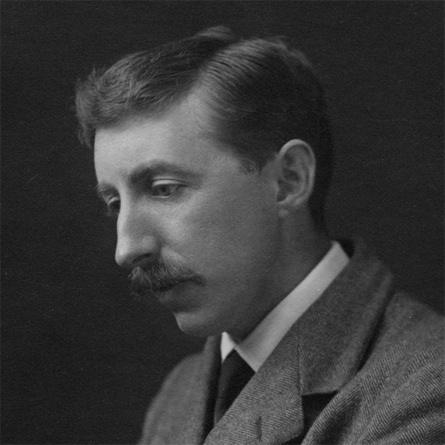
E.M. Forster 
Thirty years ago or so, a friend placed a book in my hand I had not read before, A Passage to India. I recognized the author’s name, but that was it. She had discovered the book via a film version of it released the previous year in 1984. What neither she nor I realized was that she had introduced me to a man whose words would resonate for years to come and whose social satires would bring amusement while giving me pause. 

Forster was born to middle class parents in London in 1879.  Although his father died before his second birthday, a life of relative luxury was assured via an inheritance from an aunt.  Forster attended Cambridge, became a writer, and toured the continent with his mother. His travels certainly influenced his writing.

Forster’s first published novel was Where Angels Fear to Tread.  Like A Room with a View, the novel is set in Italy and concerns a time when people did not flit off to the continent for a long weekend but often a season of travel.  In Forster’s novels, we often find English people who are interested in seeing other places and in learning about other cultures, but are convinced of their own moral and intellectual superiority. 

If I were reading Forster for the first time, I would either start with A Passage to India or Howards End. Both are beautiful books.  A Passage to India draws on Forster’s own experiences on the sub-continent where he served as private secretary to the Maharajah of Dewas, an experience he relates in his memoir The Hills of Devi.  A Passage to India is the book that I will be rereading and hope to discuss in more detail throughout the month.

Howards End may be the best choice for Austen fans who are ready to step forward into the early 20th century.  The story concerns the intertwining lives of three families:  one of modern aristocrats (i.e. the new capitalists), one intellectual (and perhaps a tad Bohemian) and one impoverished.  Those who seek a tale of redemption will find comfort at Howards End. 

Forster’s point of view is so interesting to me.  He writes as an outsider looking in and questioning conventions of the time; yet he has knowledge of the inside view so his perspective is not naïve or one-dimensional.  It has been speculated that Forster’s insight comes from his own position as a homosexual peering into conventional society.  What is apparent is that he is prepared to bring hypocrisy to the forefront—sometimes gently with humor, other times with rage or with a passion that moves this reader to tears.

I have not read Maurice, a novel that Forster did not want published in his lifetime.  It is a same-sex romance, written in the early twentieth century but not published until 1971.  Forster did not attempt to have the book published while he was alive.

While researching information on Forster for this introduction, I learned that he also penned the libretto for Benjamin Britten’s opera of Billy Budd.  I have not watched this but a 1966 BBC version is available here.

For February I have pulled my copy of A Passage to India from the shelf. On the inside cover I wrote “gift from Edith, 8/85”.  Edith left this world too early but those years here were well spent.  I am so glad that she gave me this book! 


Come join me this month as we venture into the Marabar Caves to see how we shall be transformed. 


**************************************************

Please link to your specific post and not your general blog link. In the Your Name field, type in your name and the name of the book in parenthesis. In the Your URL field leave a link to your specific post. If you don't have a blog, leave a comment telling us what you have been reading. Every week I will put up Mr. Linky which will close at the end of each book week. No matter what book you are reading or reviewing at the time, whether it be # 1 or # 5 or so on, link to the current week's post.


Sunday, January 24, 2016

BW4: Rabindranath Tagore

Rabindranath Tagore 

I finished A Suitable Boy and the story lead me on many rabbit trails looking up definitions of words, people and places in India.  Rabindranath Tagore has been mentioned quite a few times.  He won the Nobel Prize in literature in 1913, mainly for his poetry.


"because of his profoundly sensitive, fresh and beautiful verse, by which, with consummate skill, he has made his poetic thought, expressed in his own English words, a part of the literature of the West"

However, he also wrote short stories, dramas, essays as well as songs.  He was knighted by the British Government in 1915, but resigned the honor a few later in protest of British policies in India.

I have enjoyed reading his poetry and will leave you with this  


Where the Mind is Without Fear


Where the mind is without fear and the head is held high 
Where knowledge is free 
Where the world has not been broken up into fragments 
By narrow domestic walls 
Where words come out from the depth of truth 
Where tireless striving stretches its arms towards perfection 
Where the clear stream of reason has not lost its way 
Into the dreary desert sand of dead habit 
Where the mind is led forward by thee 
Into ever-widening thought and action 
Into that heaven of freedom, my Father, let my country awake.


***********************************************************************
Please link to your specific  post and not your general blog link. In the Your Name field, type in your name and the name of the book in parenthesis. In the Your URL field leave a link to your specific post. If you don't have a blog, leave a comment telling us what you have been reading.   Every week I will put up Mr. Linky which will close at the end of each book week.  No matter what book you are reading or reviewing at the time, whether it be # 1 or # 5 or so on, link to the current week's post.
/span>


Sunday, January 17, 2016

BW3: Martin Luther King


This post is brought to you by Eliana, from Well Trained Mind's 52 Books group, who offered to talk about Dr. Martin Luther King, Jr.


In the United States, Monday January 18th is Martin Luther King Day, a federal holiday honoring Dr. Martin Luther King. He was a black leader, civil rights activist, and Nobel Prize laureate. The holiday was signed into law by President Reagan in 1983, after many years of petitioning, including a song by Stevie Wonder:


The King Center includes a brief bio of Dr King, a summary of his philosophy, and a documents archive. On the History Channel, you’ll find many articles, videos, and more about Dr. King. MLK Day is also designated as a day of national service.Check out  National Service.Gov for events happening around the country as well as more information about Dr. King, lesson plans and service projects.


I'd like to start us off by sharing a video with a brief excerpt from Dr King's last speech which begins with a challenge which is at the heart of our discussion here: when will we stand by the principles we have espoused and committed to as a nation?


I volunteered for this week because our discussion last year, and my own tentative readings, had left me wanting to give more time and reading space to African American history and culture.

I had intended to write a post focused on African-American literature - novel, plays, poetry, essays - with a few history books and memoirs to round them out... and also to try to create a rough outline of some key texts. ...but our conversations this past week have shifted my intentions (though I'd still like to share the other ideas another day!).

My focus this week is on race and racism - analysis, personal reflections, fiction, poetry, and even drama.

Before drowning you all with my overflowing TBR list, I want to highlight two of the books which have been a catalyst for intense conversations and soul searching for many of us here: 

Between the World and Me: a very personal description of being a Black man of my generation, framed as a letter to his teenage son. It isn't a comfortable read, and it doesn't offer any real analysis or solutions, but it does give a vivid, powerful sense of how this one person has seen and experienced the world.

The New Jim Crow: This book draws a clear line from slavery to Jim Crow to our present-day systemic racism.  It is an essential book for understanding some of the challenges our society faces today.


As we've read and talked, I've been struggling to understand "race" - where did this concept come from? how has it shifted over the years? (and why?)

Here are 4 books which might help in this examination:


Racecraft: a collection of essays which looks at the social construct of race and the ways we  use it to try to make sense of our experiences and observations. The authors are making an analogy to the ways in which the idea of "witchcraft" has been and is used is some cultures.

History of White People: As I've thought more about the ideas of "race", I've been wondering where this "whiteness" came from. I know it hasn't always included the ethnic groups that might now be grouped under that designation (Italian, Irish, and Polish come to mind), but I want to see if this book can give me a clearer overview of how and from where our current cultural construct originated.


Two books in my stacks which touch on the same issues, but from a different angle: Whiteness of a Different Color and Working Toward Whiteness, both of which look at immigrant experiences and their efforts to become "white".


I've wondered about how we evaluate the impact of our assumptions.


Whistling Vivaldi examines the effects of stereotypes and identity, Why Are All the Black Kids Sitting Together in the Cafeteria challenges us to talk about race, with each other and with our children. Racism without Racists looks at systemic racism and its implication, and Blinded by Sight brings the startling research that the blind aren't any more colorblind than the sighted...and explodes the myth that a colorblind society would be a more just society.


But, as I struggle to find my place in this big picture issue, I am drawn to the work of Tim Wise. I recently finished his Between Barack and a Hard Place: Racism and White Denial in the Age of Obama. It isn't a deep book, or as compelling as the Coates or the Alexander, but, near the end of the book he says:


"Confronting racism is white folks' responsibility because even though we, in the present, are not to blame for the system we have inherited. We have inherited it nonetheless, and continue to benefit, consciously or not, from the entrenched privileges that are the legacy of that system... If we are to make use of the assets (as we really cannot help but do) accumulated over a period of several hundred years - including, of course, assets whose possession owes directly and indirectly to slavery and its legacy of racial subordination that enriched many and brutally oppressed many more - then we cannot, ethically, turn our backs on the debts accumulated at the same time."

...and, further on


 "...white silence is the only privilege whites can voluntarily relinquish: the rest obtain as a matter of merely living as a member of the dominant group...speaking out will not be easy: resisting injustice never is. And for white folks, so long practices at maintaining our silence, it may well be among the more daunting tasks we have undertaken. But not to do it... is to collaborate...to give our consent, to undermine our personal and national pretensions to democracy. To remain silent, to fail in this endeavor is, in a strange way, to shirk our patriotic duty...and to make our claims of national greatness out to be lies.”

And he ends with a quote from Martin Luther King Jr: "Change does not roll in on the wheels of inevitability, but comes through continuous struggle."


I want to hear more. More about what I can do, beyond hearing, beyond caring, beyond my own little garden of life. Especially given the warning sounded by Reproducing Racism which asserts that these injustices might be "locked into place" without significant structural changes *soon*.  So, I am on the hold list at my library for Dear White America.


Then I looked through my list above and I noted a glaring absence. Do you see it?


Every book above looks at racism from the assumption that it is a gender-equivalent experience. Even the little reading I have done tells me this is not true.


Although I see a number of books about race and the feminist movement (Women, Race, and Class and When and Where I Enter ( both high on my TBR list), but very little which directly addresses the issues I'm thinking about. One exception is bell Hooks' Ain't I a Woman - I tend to enjoy her writings in small doses. I have several I am nibbling at, but am not sure I will finish. But this one I will try to read all the way through.   I am also pulling a very dusty book off my shelves: In Search of Our Mothers' Gardens, which is a collection of Alice Walker's prose focusing on what it is to be a black woman, in a range of contexts.


A memoir which contrasts with Coates' on a number of levels is Negroland by Margo Jefferson.

"At once incendiary and icy, mischievous and provocative, celebratory and elegiac—here is a deeply felt meditation on race, sex, and American culture through the prism of the author’s rarefied upbringing and education among a black elite concerned with distancing itself from whites and the black generality while tirelessly measuring itself against both.”

But, perhaps, there are things which can only be expressed in fiction? Without all the statistics and other data, without how it fits into the real-life bio of the author/memoirist?


Several of us read The Sellout last year - a biting, sad, hilarious satirical novel which reached me in ways I don't think a more serious, factual account would have done.


Nella Larsen's Passing was a compelling, chilling read - and her Quicksand is now on my TBR stack.


Morrison is most renowned for the intense, horrific whirlwind that is Beloved, but I found her quieter, more realistic Home spoke to me more. (And her Playing in the Dark makes some fascinating assertions about the unspoken racial impact on much of American literature.)


Baldwin's Fire Next Time is a powerful piece of nonfiction, but I've never read any of his fiction, so I am adding If Beale Street Could Talk to my lists.


For the genre readers among us:


I am determined to finally read some Olivia Butler! Kindred is on my shelf, but there are several which have intrigued me for years. Nor have I read any Delaney... I have some trepidation, he's outside my preferred range of sci-fi, but I am glancing at Nova and Babel-17


As a break from all that prose, some poetry and drama:


Langston Hughes has long been a favorite poet; his Selected Poems is wonderful. Sonia Sanchez is a new favorite. Her Shake Loose My Skin has left me wanting more and more... it is powerful, lyrical, moving verse that gave me a glimpse of a black woman's experiences and culture.
Citizen: An American Lyric addresses many of the issues we've struggled with here, but, somehow, shook different things within me.

I also have Lorde's Black Unicorn and Komuyakaa's Neon Vernacular in my stacks - poets I've heard of, but never tried.


A Raisin in the Sun is a classic play for good reasons, and if you haven't seen or read it, I recommend it.


One can't talk about African American theater without giving a place of honor to August Wilson. His Fences is an explosively powerful, touching drama, part of a ten play cycle which traces the Black experience over ten decades.


When my husband and I went to see Othello last year, I discovered Desdemona

co-written by Morrison, which gave a different perspective on the story.

While reading No Cause For Indictment about the Newark Riots in the 60's, I was drawn to try some of  Amiri Baraka (formerly LeRoi Jones) plays.  They are not comfortable plays to experience - reading them was hard enough, I imagine seeing them would be even more harrowing. The anger and violence is shocking, but they also express a strand of reaction and experience that I've never looked at before.  His volume  of his well-known plays: Dutchman and The Slave are probably as much Jones as one can take at a time.


I am thinking of revisiting For Colored Girls Who Have Considered Suicide When the Rainbow is Enuf. I was too young when I read it as a teen.   I think I need to come back to it now.


Two other plays I read last year which don't match their more famous siblings above, but gave me valuable perspective and a reading experience I enjoyed: A Soldier's Play and Five on the Black Hand Side.


I'd like to close with a few quotes from Dr King and a brief video clip of his "How long?" speech which includes a line which speaks to my deepest hopes:

“The arc of the moral universe is long, but it bends towards justice.”


May we, soon and in our days, see this proven true.  I believe all our caring, thinking, talking, and striving are part of the bending of that arc, and I have been holding on to a quote often attributed to Dr King, but not sourced: 


 “Take the first step in faith. You don't have to see the whole staircase, just take the first step.”

(also seen as "Faith is taking the first step even when you don't see the whole staircase")


Here are a few quotes from Dr King's speeches and writings which echo, for me, some of our conversations:


“There comes a time when silence is betrayal.” - "A Time to Break Silence" [quoting, and agreeing with, an executive committee's document]
 *******
“We are challenged to  rise above the narrow confines of our individualistic concerns to the broader concerns of all humanity.” - "Facing the Challenge of a New Age"
 *******
“We are now faced with the fact that tomorrow is today. We are confronted with the fierce urgency of now. In this unfolding conundrum of life and history, there "is" such a thing as being too late. This is no time for apathy or complacency. This is a time for vigorous and positive action.”  - "A Time to Break Silence"
 ******
"We refuse to believe that the bank of justice is bankrupt. We refuse to believe that there are insufficient funds in the great vaults of opportunity of this nation" - "I Have A Dream"
 ******
"I must confess, my friends, the road ahead will not always be smooth. There will be still rocky places of frustration and meandering points of bewilderment. There will be inevitable setbacks here and there. There will be those moments when the buoyancy of hope will be transformed into the fatigue of despair. Our dreams will sometimes be shattered and our ethereal hopes blasted. We may again with tear-drenched eyes have to stand before the bier of some courageous civil rights worker whose life will be snuffed out by the dastardly acts of bloodthirsty mobs. Difficult and painful as it is, we must walk on in the days ahead with an audacious faith in the future. … When our days become dreary with low-hovering clouds of despair, and when our nights become darker than a thousand midnights, let us remember that there is a creative force in this universe, working to pull down the gigantic mountains of evil, a power that is able to make a way out of no way and transform dark yesterdays into bright tomorrows. Let us realize the arc of the moral universe is long but it bends toward justice."  - "Where Do We Go From Here?"
 ******


***********************************************************************
Please link to your specific  post and not your general blog link. In the Your Name field, type in your name and the name of the book in parenthesis. In the Your URL field leave a link to your specific post. If you don't have a blog, leave a comment telling us what you have been reading.   Every week I will put up Mr. Linky which will close at the end of each book week.  No matter what book you are reading or reviewing at the time, whether it be # 1 or # 5 or so on, link to the current week's post.